Zanzibar has launched an innovative artificial intelligence (AI)-powered drone project aimed at accelerating its fight against malaria and achieving its ambitious goal of eliminating the disease by 2029.
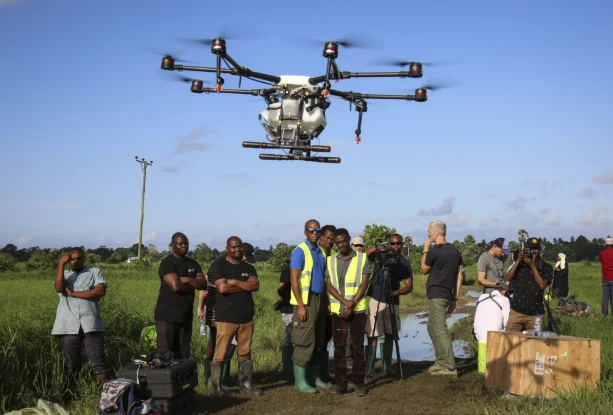
Zanzibar, Tanzania (Running Africa) – The six-month pilot initiative combines AI technology, drone surveillance and aerial mapping to identify mosquito breeding sites in hard-to-reach areas and apply larvicide with greater precision. Health officials believe the technology could significantly strengthen malaria control efforts across the archipelago.
The project is being implemented by the Zanzibar Ministry of Health and the Zanzibar Malaria Elimination Programme (ZAMEP) in collaboration with the World Health Organization (WHO), Japan-based SORA Technology, the Ifakara Health Institute and the Government of Japan, which is providing financial support.
AI Drones to Strengthen Malaria Control in Zanzibar
The AI-powered drones are designed to locate mosquito breeding grounds that are often difficult to identify through conventional methods. By using aerial mapping and advanced data analysis, the technology allows health teams to target interventions more efficiently, reducing the spread of malaria-carrying mosquitoes.
Officials say the initiative will complement existing malaria prevention strategies that have helped Zanzibar achieve remarkable progress over the past two decades.
Malaria prevalence on the islands has fallen from more than 40% in previous years to below 1%, with current estimates placing the rate at approximately 0.04%. The dramatic decline has positioned Zanzibar among Africa’s leading malaria control success stories.
Addressing Evolving Malaria Challenges

Health experts note that changing mosquito behavior remains a significant challenge in the fight against malaria. Increasing outdoor transmission and early-evening mosquito biting have reduced the effectiveness of some traditional control measures, creating a need for more targeted and innovative solutions.
The deployment of AI-driven drones is expected to help health authorities respond more effectively to these evolving transmission patterns while improving surveillance and intervention efforts.
Generating Evidence for Africa’s Malaria Fight

Beyond supporting Zanzibar’s malaria elimination strategy, the pilot project will also evaluate the effectiveness of drone-based larviciding compared to conventional methods. Researchers hope the findings will provide valuable evidence to guide future malaria control programs in Zanzibar and other African countries.
If successful, the initiative could serve as a model for how artificial intelligence and drone technology can be integrated into public health systems to combat malaria, which continues to pose a major health challenge across the continent.
With Zanzibar moving closer to its malaria elimination target, the AI-powered drone project represents another step forward in the use of technology-driven solutions to improve health outcomes and strengthen disease prevention efforts in Africa.