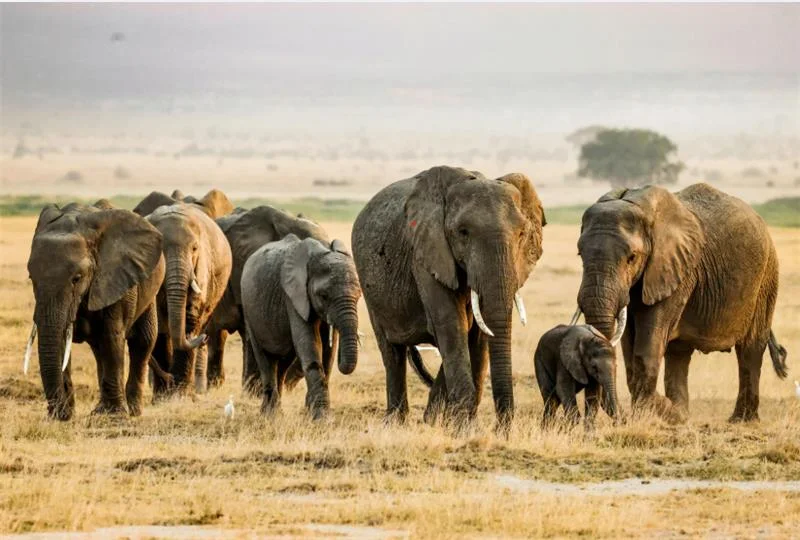
Amboseli, Kenya (Running Africa) — Kenyan authorities have arrested four suspects and seized chemicals as investigators examine whether cyanide poisoning caused the deaths of 18 elephants in the Amboseli ecosystem, one of the country’s most important wildlife conservation areas.
The four suspects have since been released on bail and have not been found responsible for the deaths. Investigators are also searching for a fifth person of interest as they work to establish how the elephants were exposed to the suspected toxic substance.
Preliminary laboratory findings suggest poisoning may have caused the deaths, with investigators examining a possible link to pesticide-contaminated tomatoes from farms bordering Amboseli National Park.
Four Arrested Over Amboseli Elephant Deaths
The arrests mark a significant development in an investigation that began after elephants started dying under unusual circumstances in the Amboseli ecosystem.
Authorities searched locations in Loitoktok sub-county, where chemicals believed to have originated from a neighboring country were recovered.
Investigators are examining whether those substances have any connection to the elephant deaths.
The four people detained during the investigation were subsequently released on bail, while authorities continue searching for another person of interest.
Officials have stressed that the arrests do not establish criminal responsibility and that the investigation remains ongoing.
Cyanide Poisoning Investigated as Possible Cause
Preliminary laboratory results indicate that a toxic substance may have killed the elephants, with cyanide among the substances being investigated.
One line of inquiry is whether the animals consumed tomatoes contaminated with pesticides from farms bordering Amboseli National Park.
The theory could point to an intersection between agriculture and wildlife conservation in communities surrounding the protected area, where elephants can move between parkland and neighboring farms.
However, investigators have not yet announced a definitive cause of death.
Elephants Reportedly Suffered Paralysis Before Death
The first 15 elephant deaths were recorded between June 24 and July 24, 2026, before the number under investigation increased to 18.
Affected elephants reportedly displayed unusual symptoms, including partial paralysis, before dying within one or two days.
Those symptoms prompted authorities to investigate possible poisoning and collect samples for laboratory testing.
Determining the precise toxin and how the elephants encountered it will be central to establishing whether the deaths resulted from deliberate poisoning, accidental contamination or another cause.
Wildlife Experts Question Pesticide-Contaminated Tomato Theory
Some wildlife experts have questioned whether pesticide contamination alone explains the deaths.
One significant concern is the apparent absence of unusual fatalities among other wildlife and animals in the Amboseli ecosystem.
If contaminated agricultural produce were widely accessible, experts say investigators will need to explain why elephants appear to have been disproportionately affected.
That uncertainty means the pesticide theory remains one possibility rather than an established explanation.
Amboseli Elephant Deaths Raise Conservation Concerns
The deaths have attracted attention because the Amboseli ecosystem is one of Kenya’s best-known elephant habitats and an important conservation and tourism area.
Elephants frequently move across the wider landscape rather than remaining exclusively within the boundaries of Amboseli National Park, bringing them into contact with farms and settlements.
That movement has long created challenges surrounding human-wildlife conflict, agricultural losses and wildlife protection.
If investigators establish that agricultural chemicals played a role, the case could raise wider questions about pesticide management in communities bordering protected wildlife areas.
Investigation Into 18 Elephant Deaths Continues
Kenyan authorities have not yet determined whether the elephants were deliberately poisoned or accidentally exposed to a toxic substance.
Laboratory testing, analysis of the chemicals seized in Loitoktok and the search for the fifth person of interest are expected to form key parts of the continuing investigation.
The release of the four suspects on bail also means authorities have yet to establish individual criminal responsibility.
For now, cyanide poisoning remains under investigation rather than a confirmed cause.
With 18 elephants dead in one of Kenya’s most important conservation landscapes, determining exactly what happened in Amboseli will be critical both for the investigation and for preventing further wildlife deaths.