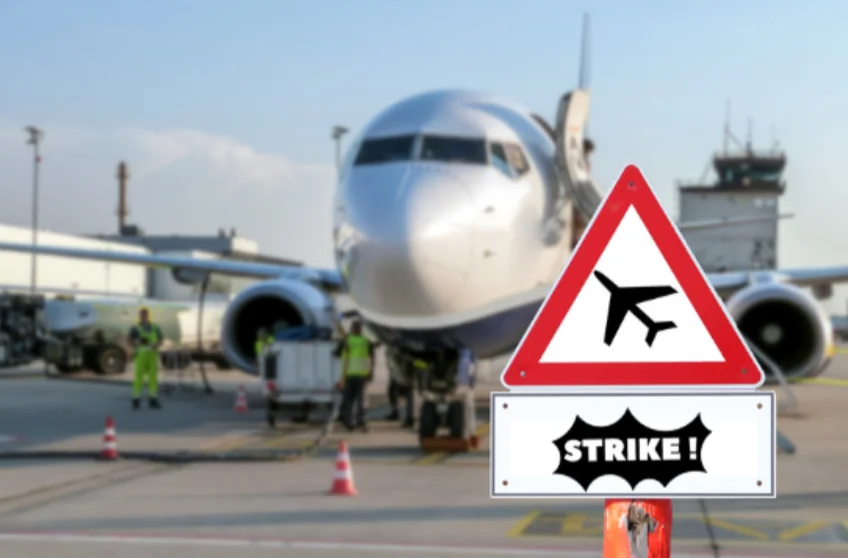
Nairobi, Kenya (Running Africa) — Kenya’s aviation workers have ended a two-day strike that disrupted flights and stranded thousands of passengers, but longstanding disputes over pay, collective bargaining and union rights remain unresolved.
Workers returned to duty on September 1 after overnight negotiations between the Kenya Aviation Workers Union (KAWU), government officials and aviation agencies produced a return-to-work agreement.
The strike affected Jomo Kenyatta International Airport (JKIA) in Nairobi, Moi International Airport in Mombasa, Kisumu International Airport and Eldoret International Airport, with delays also affecting regional air travel.
Why Kenya’s Aviation Workers Went on Strike
The industrial action followed years of disagreements involving KAWU, the Kenya Airports Authority (KAA), Kenya Civil Aviation Authority (KCAA) and low-cost carrier Jambo jet.
At the center of the dispute are stalled collective bargaining agreement (CBA) negotiations, salary issues, unpaid agency fees, union recognition and allegations of worker victimization.
Previous agreements in February and July failed to deliver a lasting settlement, prompting workers to resume industrial action on August 30.
Transport Cabinet Secretary Davis Chirchir, Labor Cabinet Secretary Alfred Mutua and COTU Secretary-General Francis Atwoli were among senior officials involved in talks to end the latest strike.
New Deal Sends Workers Back to Negotiations
Under the return-to-work agreement, outstanding agency fees held by KAA are to be remitted to KAWU, while the union and KCAA will resume negotiations over their long-running CBA.
The Salaries and Remuneration Commission has issued new parameters to guide salary negotiations after withdrawing earlier guidance.
Other grievances raised by the union are expected to go through an agreed dispute-resolution process, while workers who participated in the strike are protected from victimization or disciplinary action solely for taking part.
However, KAWU’s dispute with Jambo jet over union recognition remains before the courts.
Flight Disruptions Highlight Kenya’s Aviation Risks
The strike caused widespread cancellations and delays, forcing airlines to rebook passengers and clear significant backlogs once operations resumed. Cargo movements were also affected.
The disruption underlined the importance of Kenya’s airports to East Africa’s wider transport and business network.
Although flights are operating again, the latest agreement faces a familiar challenge: turning promises into lasting solutions.
For Kenya’s aviation sector, the threat of another strike will remain until the disputes over wages, collective bargaining and union recognition are finally resolved.